
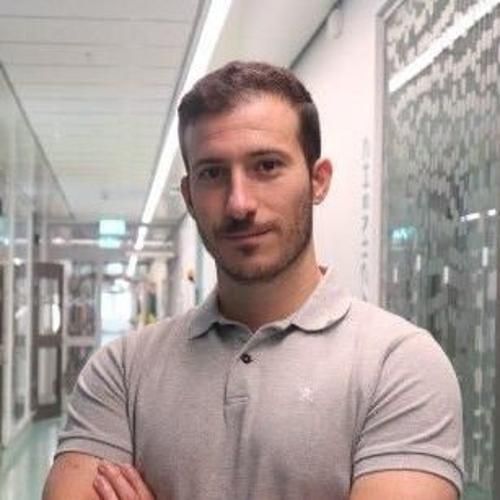

Rafael Ceña Diez
| AREA | RESEARCH GROUP | |
|---|---|---|
| Microbiology | Infection and Immunobiology |
I began my research career after completing a Master's Degree in Molecular and Cellular Biology (UAM, Madrid, 2014) by joining the Molecular Immunobiology Laboratory directed by Dr Muñoz-Fernández at the Health Research Institute of Gregorio Marañón Hospital. During my pre-doctoral studies, I focused on the development of nanotechnology as a prophylaxis against sexually transmitted viruses, demonstrating the ability of various dendrimers to inhibit HIV-1 and HSV-2 infections.
My multidisciplinary training was enriched by stays at internationally renowned chemistry centres: in 2017, I completed a stay at the Leibniz Institute for Polymer Research (IPF) in Dresden, Germany, where I expanded my knowledge of inorganic chemistry and polymer synthesis, modification and characterisation. Subsequently, during my postdoctoral studies, I collaborated with the Royal Institute of Technology (KTH) in Stockholm, developing expertise in advanced biomaterials that complemented my biomedical training.
My international experience was consolidated when I joined the Karolinska Institute (Stockholm, Sweden) as a postdoctoral researcher in 2019, where I established extensive international collaborations and developed experimental, translational and clinical research projects focused on infectious diseases. In 2022, my progression towards research independence accelerated significantly when I became Team Leader of the antivirals team.
In 2023, I obtained R3 certification (established researcher) and, since April 2025, I have been a Ramón y Cajal researcher at the University of Valladolid, where I continue to develop my research career in the fields of microbiology, immunology and biomedicine.
I study the development of innovative antiviral agents for the prevention and treatment of infectious diseases, including HIV-1, HPV, and HSV-2. My current research focuses on the development of topical vaginal microbicides using multidisciplinary approaches, as well as the development of antivirals against respiratory viruses. I have successfully established my own line of research through international collaborations in the field of virology and biomaterials to study the preclinical and translational potential of new compounds.
In this context, one of my main lines of research focuses on vaginal mucosal immunity and the complex relationship between the immune system and the microbiota. Through this multidisciplinary approach, we aim to study and identify new determinants of infection that could revolutionise our understanding of the mechanisms of susceptibility and resistance to pathogens in the female reproductive tract. This research is fundamental to the development of more effective and personalised preventive strategies.
Mi visión es desarrollar nuevas estrategias profilácticas y terapéuticas que puedan reducir significativamente la transmisión del VIH y otras infecciones de transmisión sexual, así como contribuir al desarrollo de nuevos antivirales respiratorios. Aspiro a trasladar mis descubrimientos desde el laboratorio hasta aplicaciones clínicas reales, manteniendo colaboraciones internacionales sólidas y contribuyendo a la salud pública global a través de la investigación biomédica.